
Among the many design principles, one set that is particularly widely respected is the “Ten principles for good design” defined by Dieter Rams, also known as the Ten Principles of Good Design from the German company Braun.

- Good design is innovative
It does not copy existing product forms, nor does it produce any kind of novelty for the sake of it. The essence of innovation must be clearly seen in all functions of a product. The possibilities in this respect are by no means exhausted. Technological development keeps offering new chances for innovative solutions.
Good design should be innovative.
The possibilities for innovation are endless and never exhausted. The rapid development of technology continuously provides new opportunities for innovative design. At the same time, innovative design always progresses alongside technological advancement and is never finished.
- Good design is aesthetic
The aesthetic quality of a product – and the fascination it inspires – is an integral part of its utility. Without doubt, it is uncomfortable and tiring to have to put up with products that are confusing, that get on your nerves, that you are unable to relate to. However, it has always been a hard task to argue about aesthetic quality, for two reasons.
Good design is aesthetic.
The aesthetic quality of a product is an integral part of its utility, because the products we use every day constantly influence us and our lives. However, only things crafted with excellence can be beautiful.
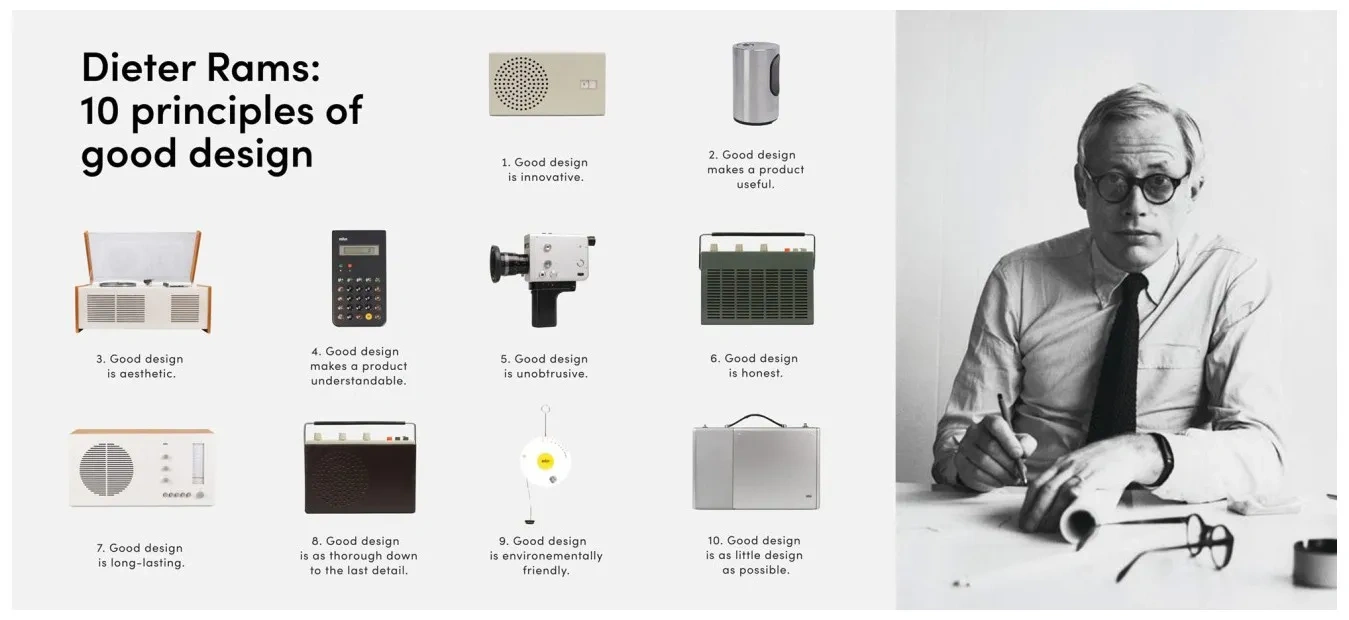
- Good design makes a product understandable
It clarifies the structure of the product. Better still, it can make the product talk. At best, it is self-explanatory and saves you the long, tedious perusal of the operating manual.
Good design makes a product easier to understand.
Good design makes the structure of a product clear. Even better, it can make the product speak for itself. Ideally, everything should be self-explanatory.
- Good design is unobtrusive
Products that satisfy this criterion are tools. They are neither decorative objects nor works of art. Their design should therefore be both neutral and restrained, leaving room for the user’s self-expression.
Good design is unobtrusive.
Products should be like tools that serve a purpose. They are neither decorative objects nor works of art. Therefore, they should be moderate and restrained, leaving some room for the user’s personal expression.
- Good design is honest
An honestly-designed product must not claim features it does not have – being more innovative, more efficient, of higher value. It must not influence or manipulate buyers and users.
Good design is honest.
Do not exaggerate the product’s creativity, powerful features, or its value. Nor should you attempt to deceive consumers with promises that cannot be fulfilled.
- Good design makes a product useful
A product is bought in order to be used. It must serve a defined purpose – in both primary and additional functions. The most important task of design is to optimise the utility of a product.
Good design makes a product more useful.
A product is bought to be used. It must at least meet certain basic standards, not only in function but also in the user’s purchasing psychology and the product’s aesthetics. Good design emphasizes practicality without neglecting other aspects; otherwise, the product will be significantly diminished.
- Good design is long-lasting
It is nothing trendy that might be out-of-date tomorrow. This is one of the major differences between well-designed products and trivial objects for a waste-producing society. Waste must no longer be tolerated.
Good design stands the test of time.
It prevents products from becoming short-lived fads and instead makes them appear timeless. Unlike fashionable design, it is accepted and used for many years, even in today’s society flooded with disposable goods.
- Good design is thorough down to the last detail
Thoroughness and accuracy of design are synonymous with the product and its functions, as seen through the eyes of the user.
Good design is thoughtful and leaves no detail overlooked.
No detail should be handled carelessly or with wishful thinking. Diligence and precision in the design process are a form of respect for the consumer.
- Good design is environmentally friendly
Design must contribute towards a stable environment and a sensible use of raw materials. This means considering not only actual pollution, but also the visual pollution and destruction of our environment.
Good design is environmentally conscious.
Design can make a significant contribution to environmental protection. It should minimize resource waste throughout the product’s lifecycle, reduce damage to nature, and avoid creating visual pollution.
- Good design is as little design as possible
Good Design is as little design as possible.
Back to purity, back to simplicity.
Good design is minimal.
Minimal, but better – because it concentrates on the essential factors a product must have and eliminates the unnecessary. “The ultimate sophistication is simplicity, and the ultimate destination is plainness.”
Reposted from: Zhihu
💡 Thank you for reading! Feel free to share this article or write to me to exchange ideas.
The RSS feed address for this site has been updated. Please resubscribe, dear readers!