As a child who grew up in southern China, my family always enjoyed watching CCTV news during meals. It was during these times that I learned about the city of Beijing, bit by bit. It sparked a deep curiosity in me, and I always hoped to visit one day.
In 2018, a project hiatus gave me a short vacation. I thought to myself, why not go to Beijing? I wanted to see the ancient architecture within the city, like the Forbidden City and the Old Summer Palace.
My first stop was a visit to the Forbidden City. Its grand scale was captivating, making it hard to leave. When I stepped inside, the ancient palaces left a profound impression on me. The undulating eaves on the old palaces, the antique red walls and green tiles, the arched thresholds, and the historic great halls—every corner was imbued with ancient cultural atmosphere. Being able to stand alongside the mythical guardian beasts and ancient architecture gave me a sense of what it might have been like to live in ancient times, a feeling of traveling through time.

Within the Forbidden City, I also had the fortune to visit the Lingzhao Xuan (Crystal Palace), commissioned by Empress Dowager Longyu. This is a copper-cast building with glass walls. Between the wall layers, water was kept to raise fish, and the ground floor was also made of glass, allowing one to see fish swimming playfully in the pool below. The Crystal Palace and its design style made me appreciate the fusion of Chinese and Western cultures, leaving me in deep admiration.
“In the first year of the Xuantong reign (1909), construction began on the original site of the main hall of Yanxi Palace for a three-story Western-style ‘Water Palace.’ The Water Palace was surrounded by a pool, fed by water from the Yuquan Mountain. The main building had nine rooms on each floor, with a door on each of the four sides—east, west, south, and north—at the ground level, surrounded by a corridor. At each corner of the main building, a three-story hexagonal pavilion was attached, each with two doors at ground level connecting to the main building and the corridor. According to records in ‘Qing Gong Ci’ and ‘Qing Bai Shi,’ the Water Palace had copper beams and glass walls, with water and fish kept between the wall layers. The ground floor was made of glass, allowing a view of fish swimming and lotus algae below. Empress Dowager Longyu inscribed a plaque for it, calling it ‘Lingzhao Xuan,’ commonly known as the ‘Crystal Palace.’ In reality, the entire structure was made of cast iron, and the four coiling dragon pillars inside were also forged from iron. Most of the building was constructed with white marble, using very few bricks. The exterior walls were carved with patterns, and the interior walls were lined with white and patterned tiles. Due to empty state coffers, the Crystal Palace remained unfinished by the winter of the third year of the Xuantong reign (1911) and was subsequently halted. In the sixth month of the second year of Xuantong (1910), Empress Dowager Longyu also ordered the Xiyuan Electric Light Company to install electric heaters, electric fans, and additional electric lights in Yanxi Palace.”
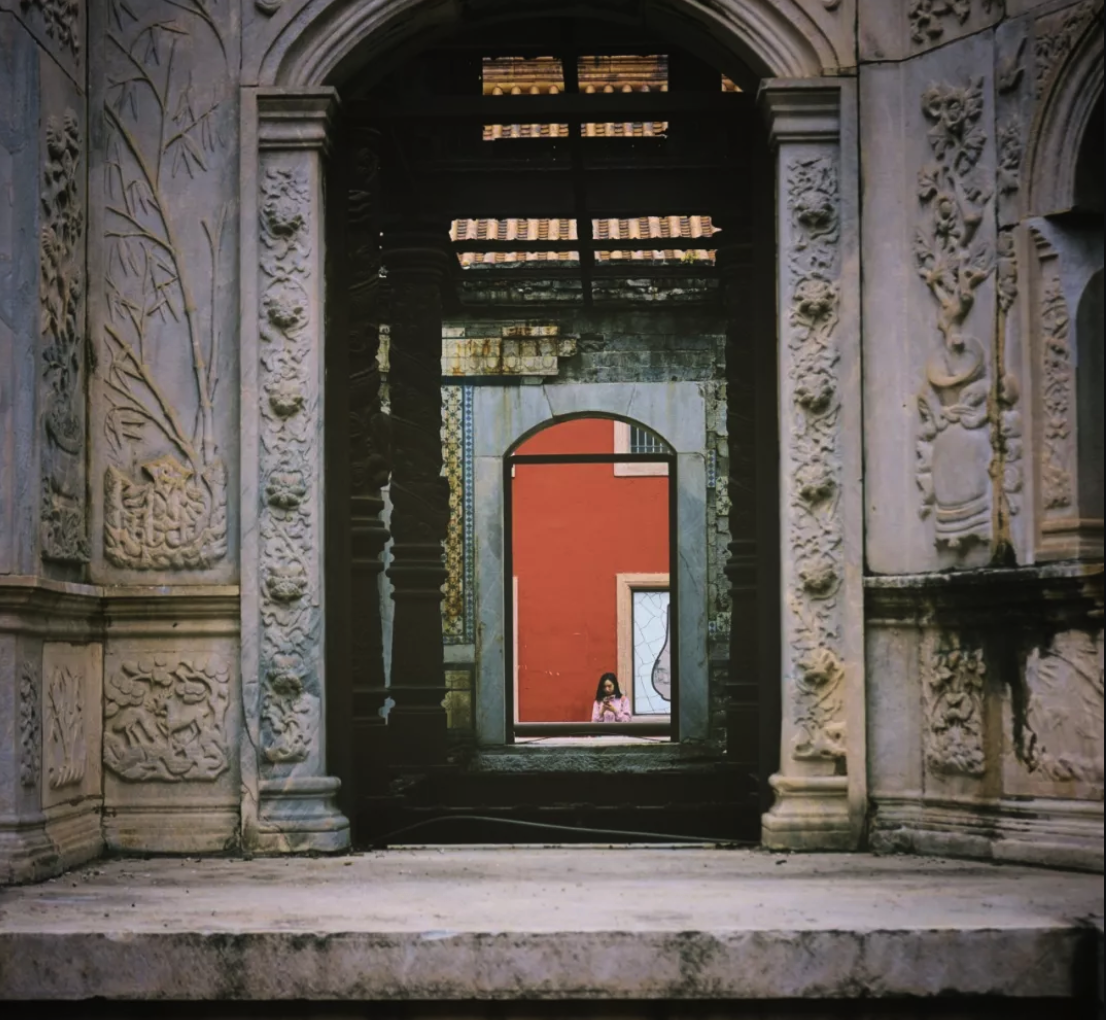
Through the remnants of ancient architecture, we can glimpse the lives of people from that era and imagine their living conditions. Walking across the iron bridge and entering the Crystal Palace, I felt the clash of Eastern and Western cultures. The fashionable Western-style architecture might have brought new topics to this ancient palace city, forming the trendiest popular culture of its time.
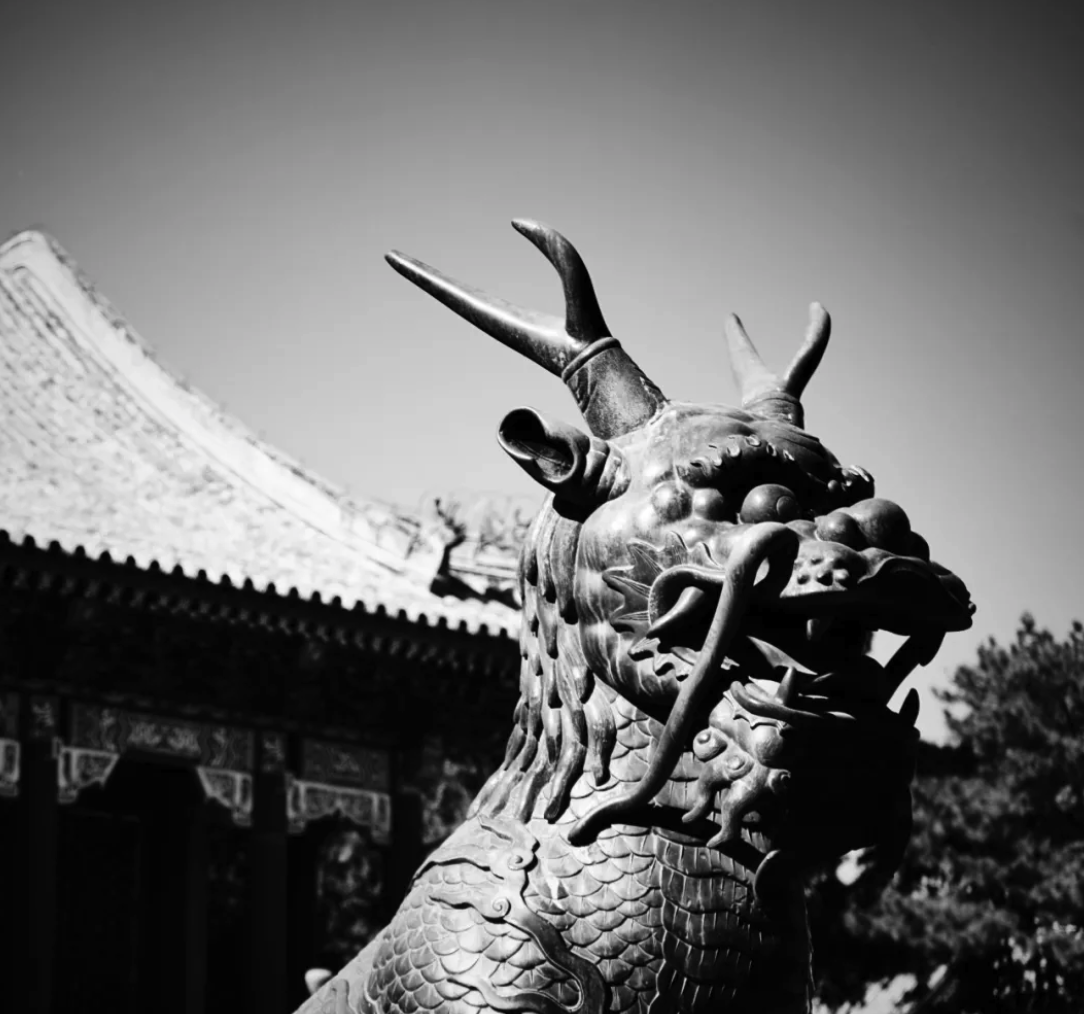
Guarded by auspicious beasts, this ancient palace city, through the turning of years and seasons, once held a fragment of my memory. It was a warmth and surprise I discovered within these palace walls, a cherished moment deeply etched in my heart, never to be forgotten.
On my second day in Beijing, I wandered to the East Palace Gate. After passing through the turnstile, I paused before this sign.
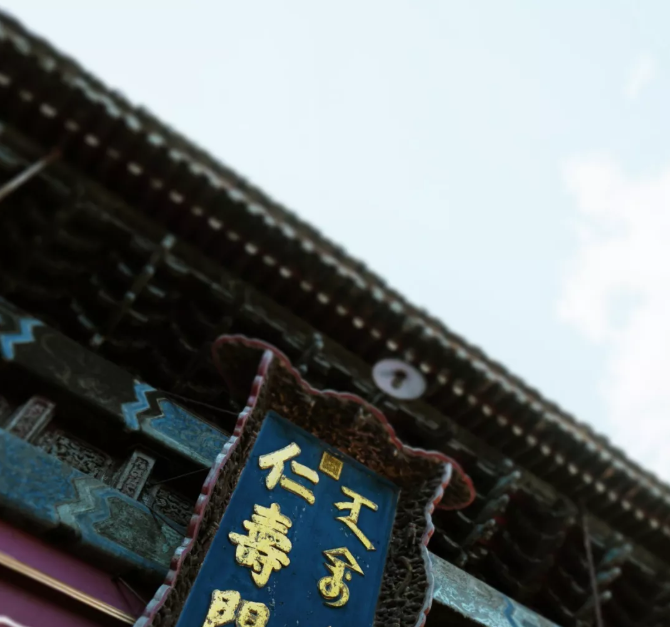
Renshou Gate, the front gate of the Hall of Benevolence and Longevity, where Empress Dowager Cixi once held court and received congratulations from foreign envoys. In those days, the Qing Dynasty was still a powerful empire.

Passing through the Hall of Benevolence and Longevity, I arrived at the Moon-Inviting Gate behind the hall, part of the Long Corridor. Experiencing the mild warmth of October weather gave me a slight fondness for Beijing.
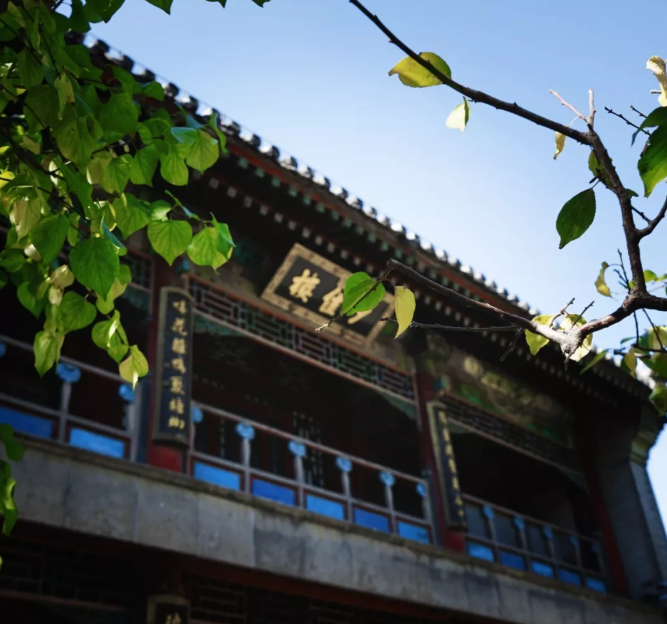
Looking out the window, I saw the famous scenery of Longevity Hill—my next destination!


Walking up the mountain path, I encountered a cute squirrel.
For my third stop in Beijing, I visited the ruined “Garden of Gardens.” Seeing the vibrant vitality of the plants contrasted with the dilapidated architecture stirred complex emotions in my heart.


Seeing the exquisite design of Beijing’s ancient gardens made me lament the relative lack in Lingnan garden design. Upon entering, I saw a grove of willow trees. A gentle autumn breeze was blowing, making me sigh at the sheer beauty of the scene.
The Jianbi Pavilion could be seen not far from the entrance. Passing through the willows and crossing the bridge, I walked around the structure, admiring its beauty. Under the trees grew graceful reeds, perfectly matching my imagined vision of autumn.
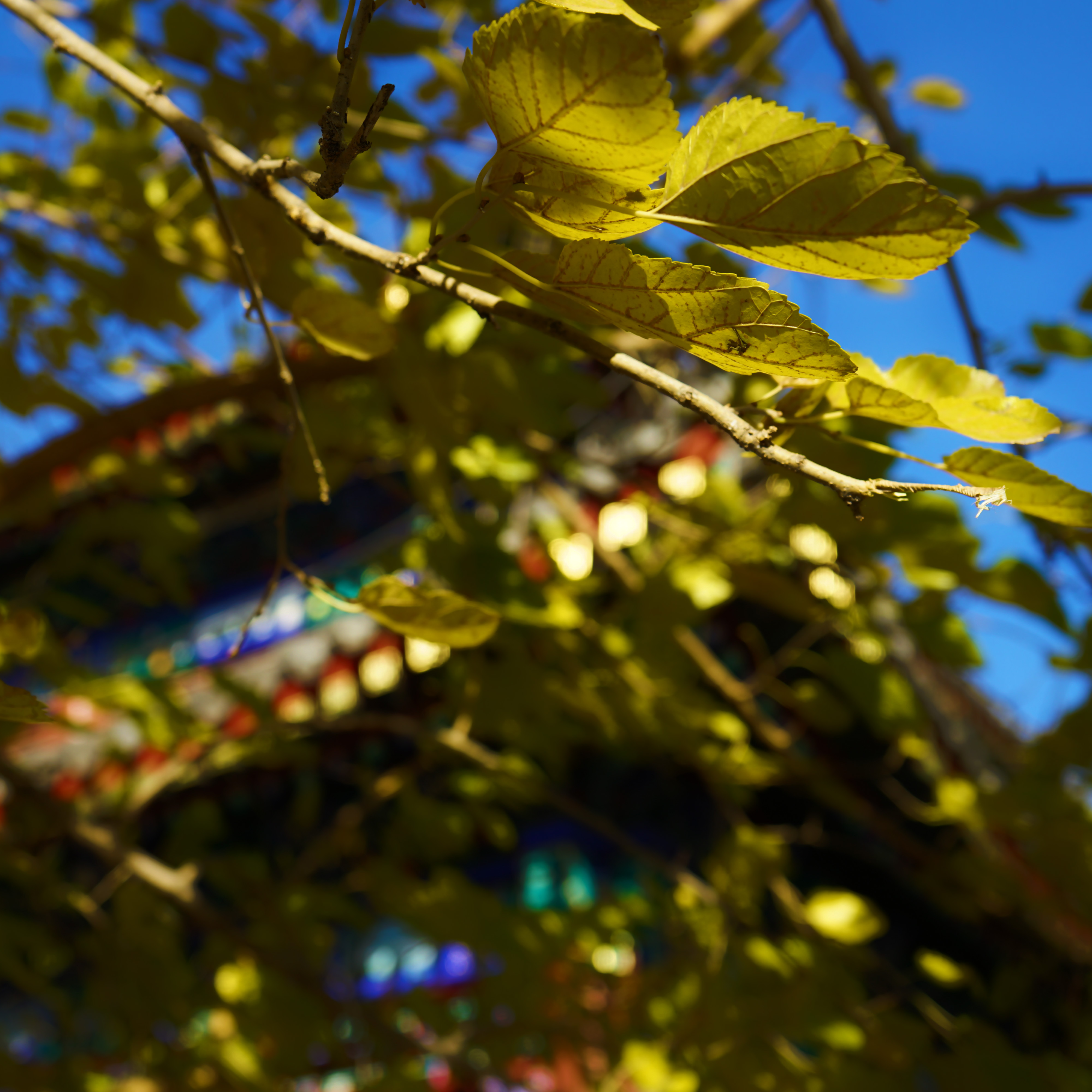
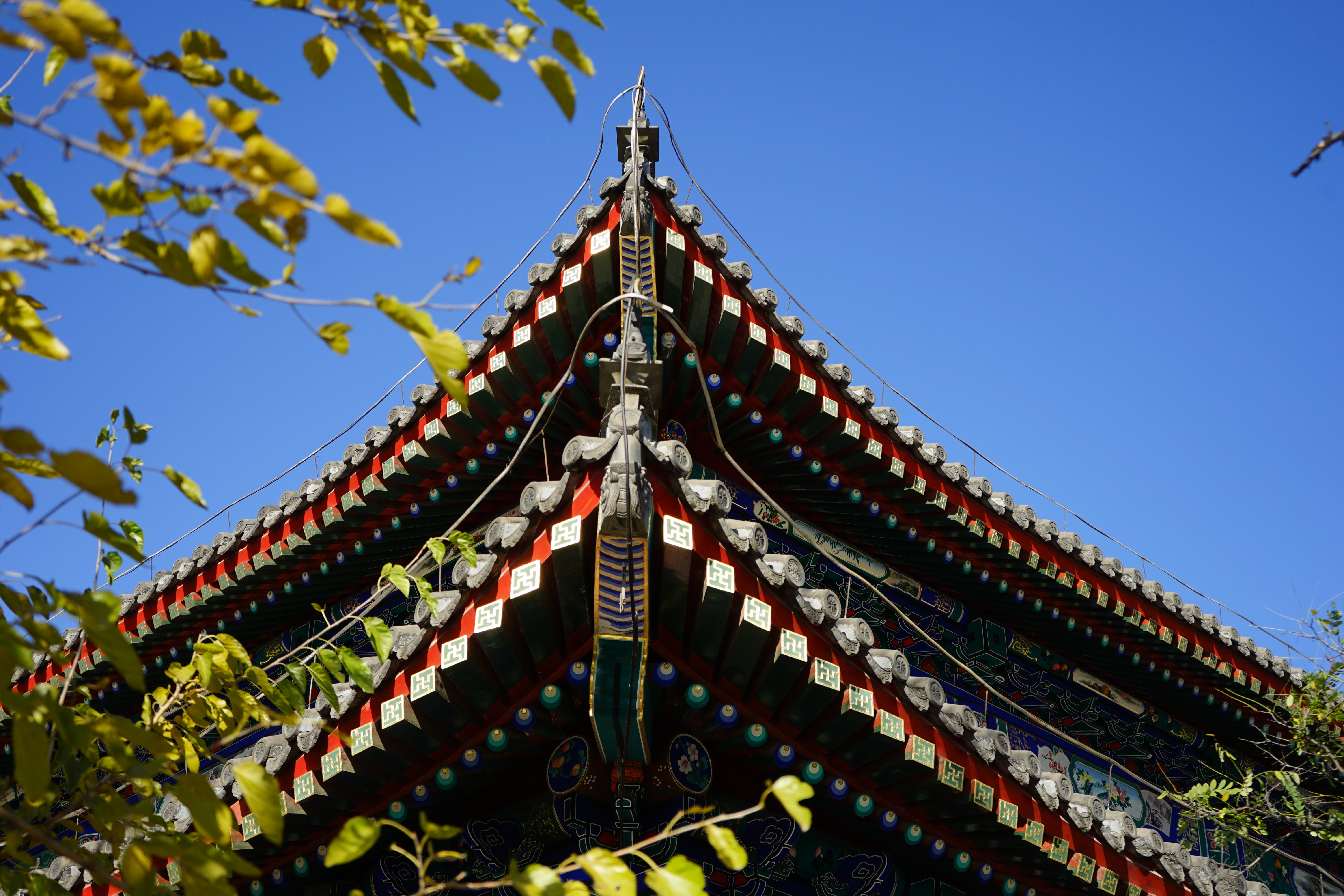
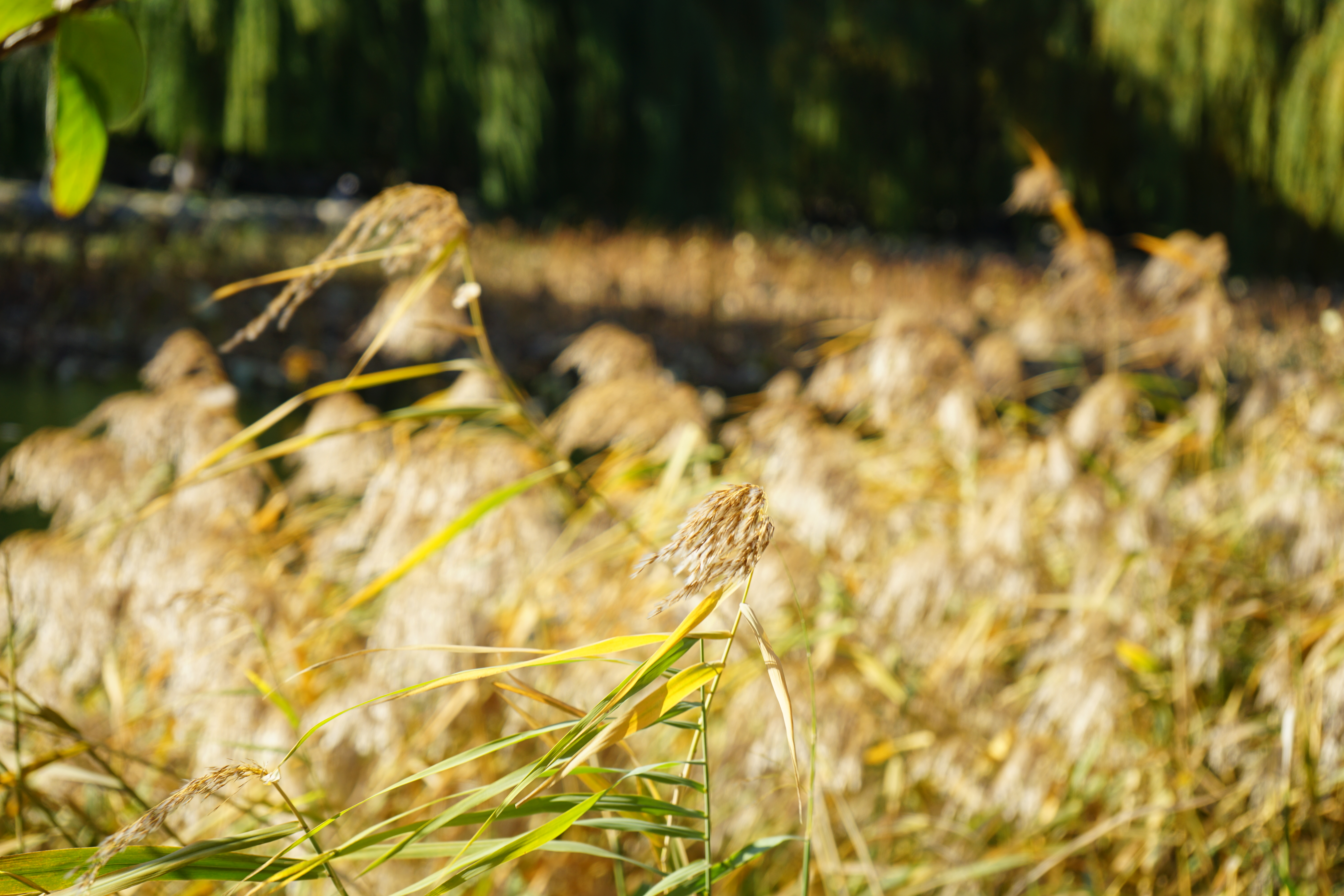
Wandering around, I arrived at Fuhai (Sea of Blessings) and saw a golden street, which made me stop in my tracks. I caught the scent of autumn in the air. Walking along the base of the wall, I saw vegetation covering the entire surface, and the thought of returning to become a farmstead owner floated into my mind again.
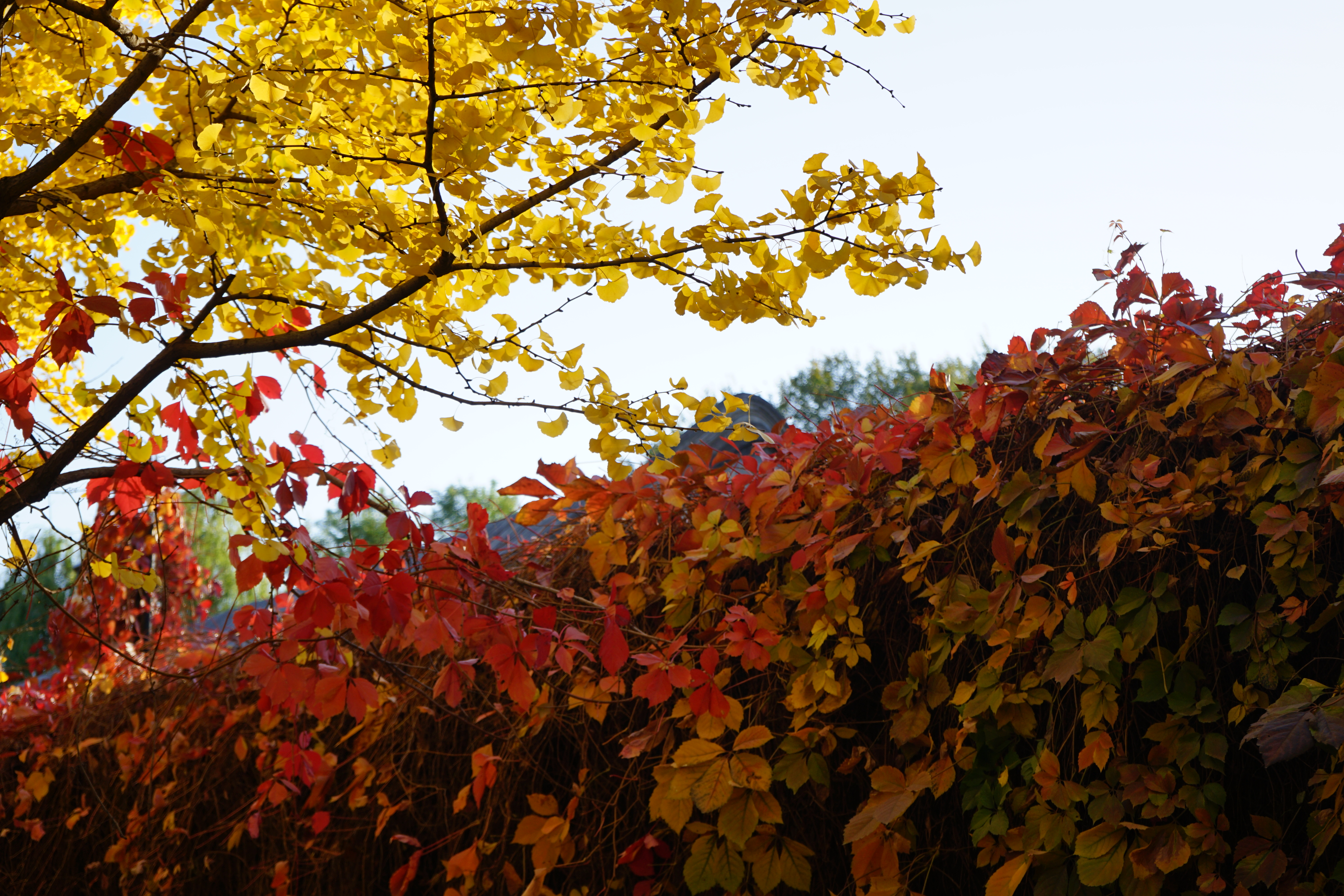

Fenglin Zhou (Phoenix and Kylin Isle) is a peninsula in the center of the lake, one of the main scenic spots of the Old Summer Palace. On Fenglin Zhou, surrounded by the lake on three sides, one can enjoy the most beautiful views of the lake, with winding bridges leading to secluded spots.
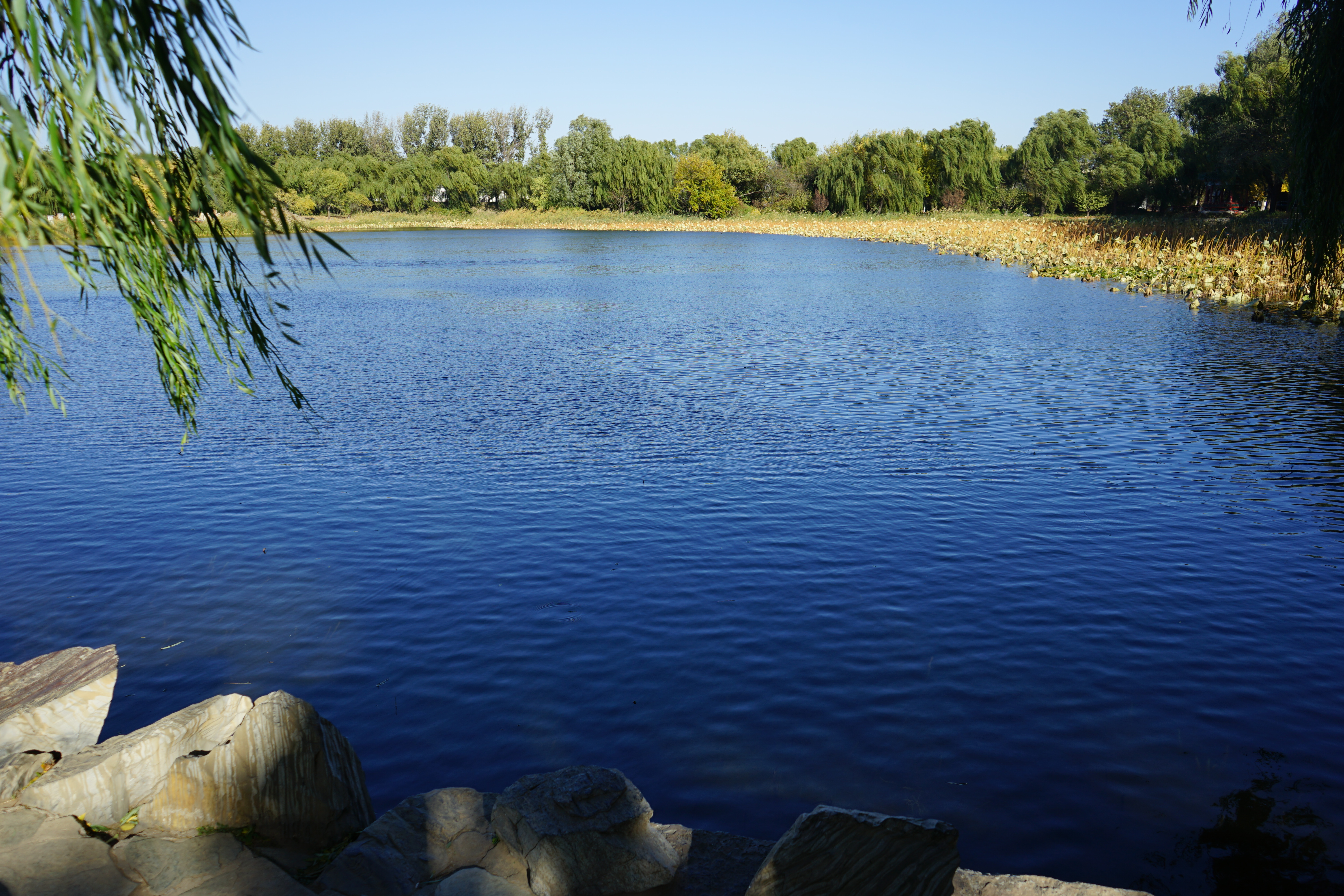
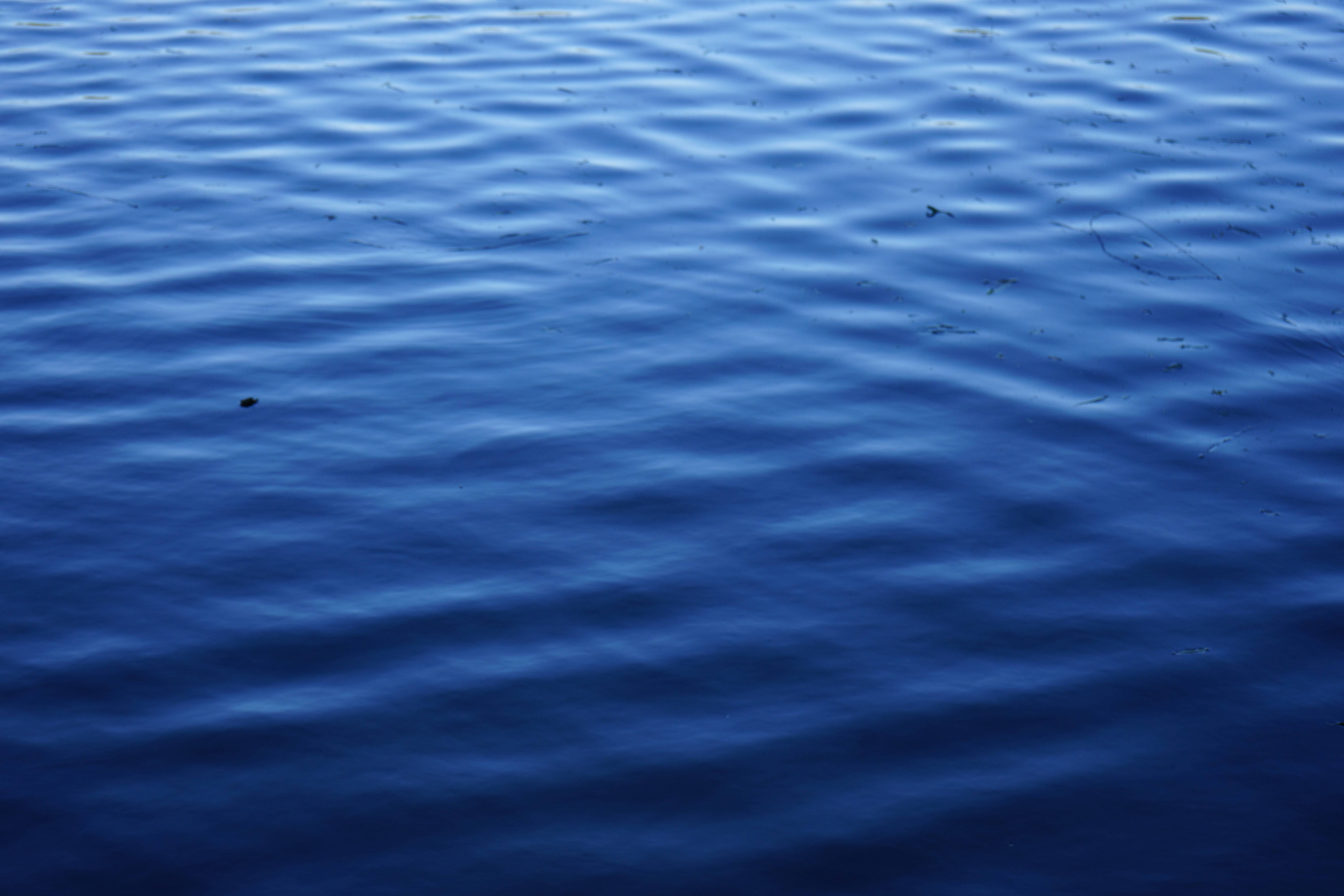
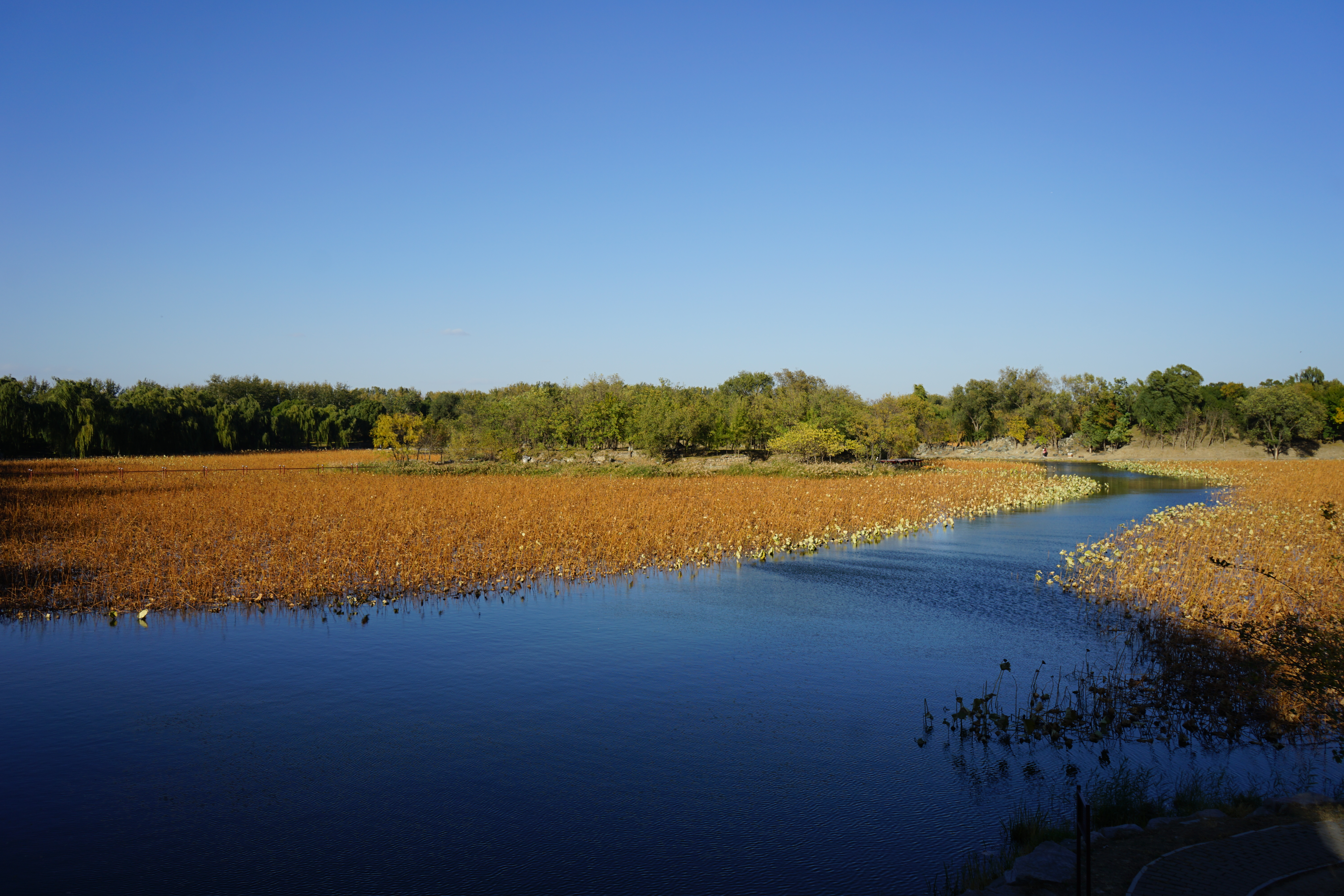
Walking to the area around Fenglin Zhou, the lake water gradually took on a deep blue hue. The shore was lined with withered lotus leaves, full of autumn atmosphere.
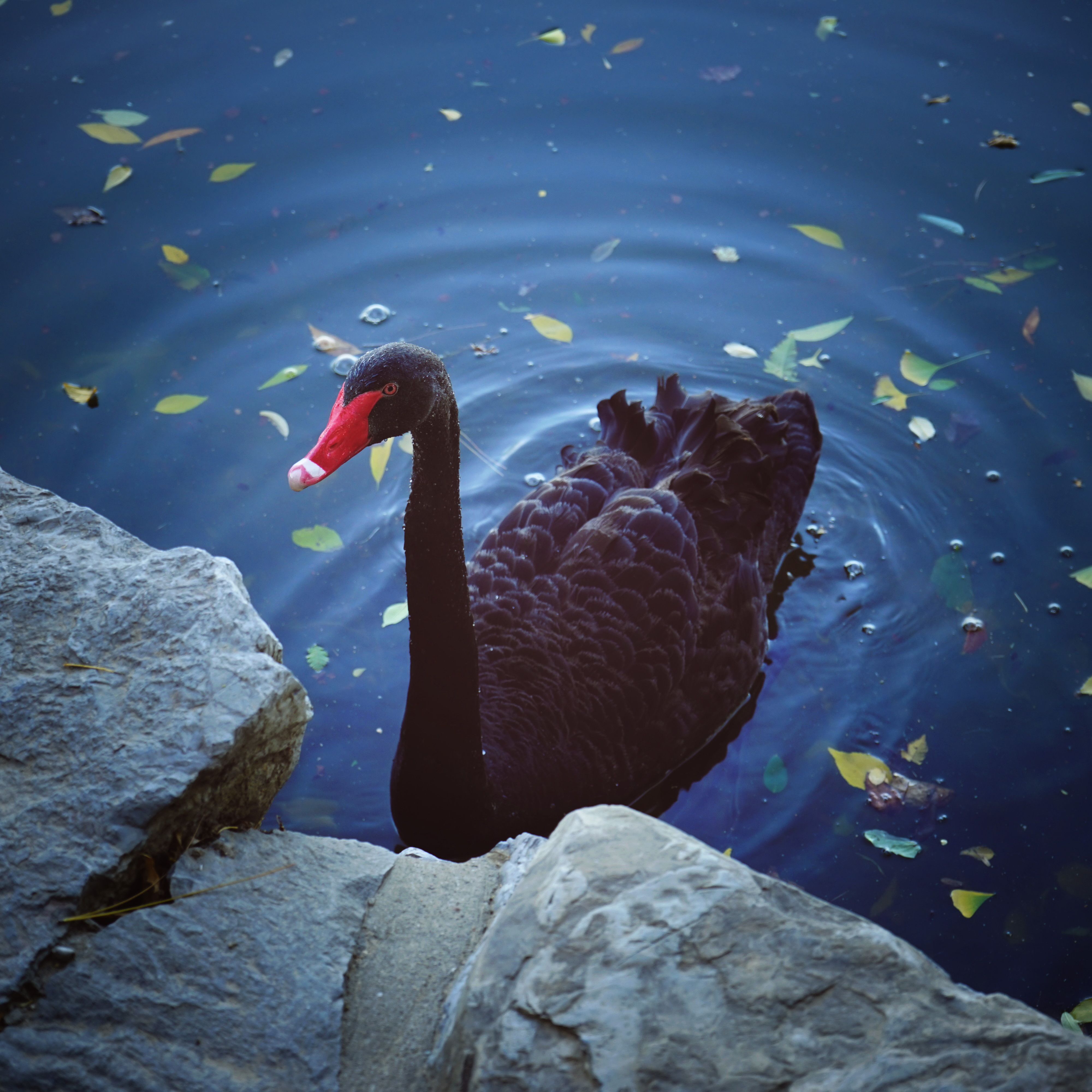
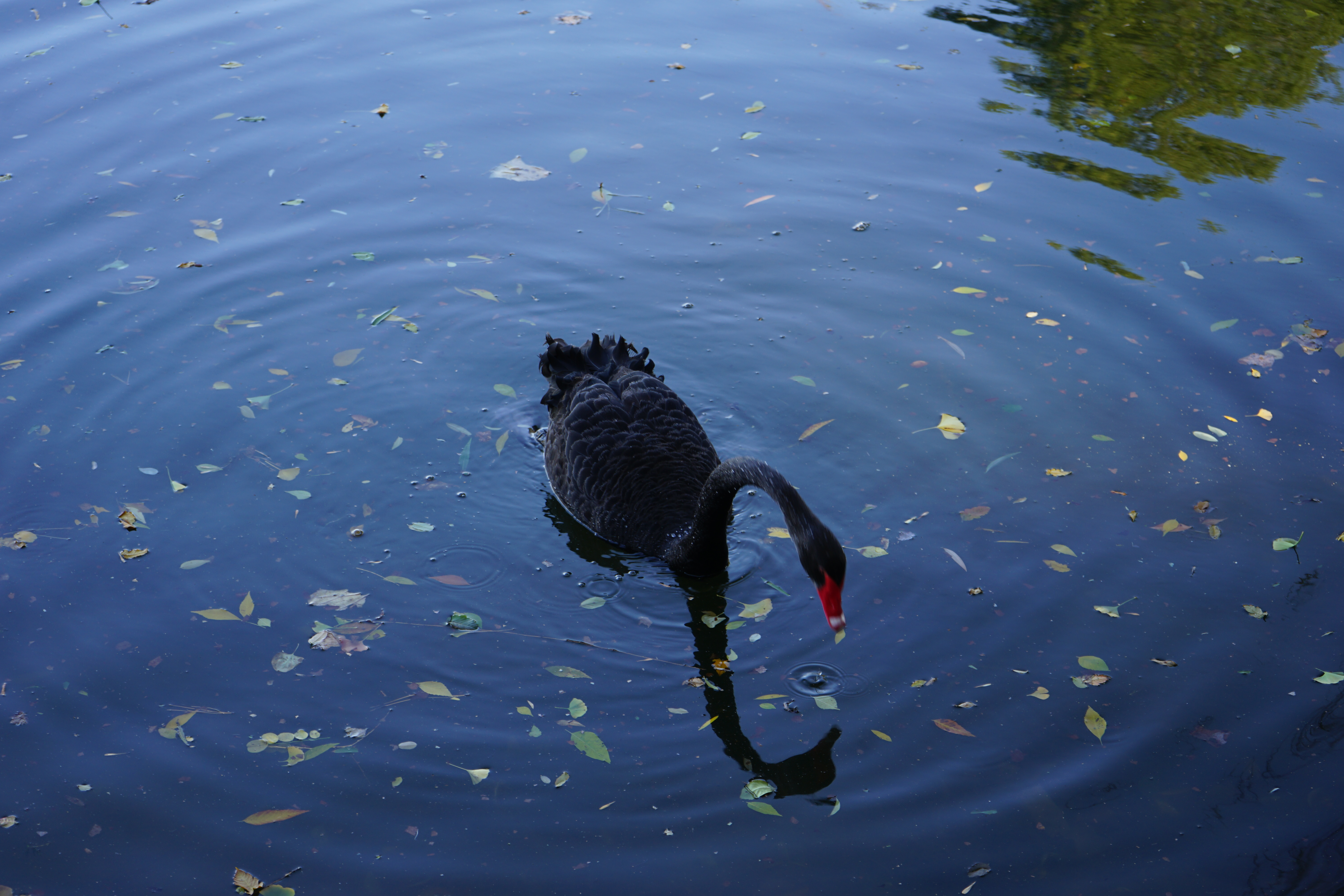
The black swan viewing area in the Old Summer Palace is located in the waters near the Jade Exquisite Hall. The swans come from a pair of black swans that have lived for many years in the waters near the Lion Grove by the East Gate, along with their three cygnets. Three staff members take turns on duty to care for them, gradually forming a new scenic area in the Old Summer Palace where black swans can be observed at any time.
Following the path, I reached the black swans’ habitat. Just as I was passing under a bridge arch, this little fellow swam over leisurely and even ate small fish in the water, satisfying the curiosity of us spectators on the shore. Now I’m someone who has seen a black swan! Hahaha.
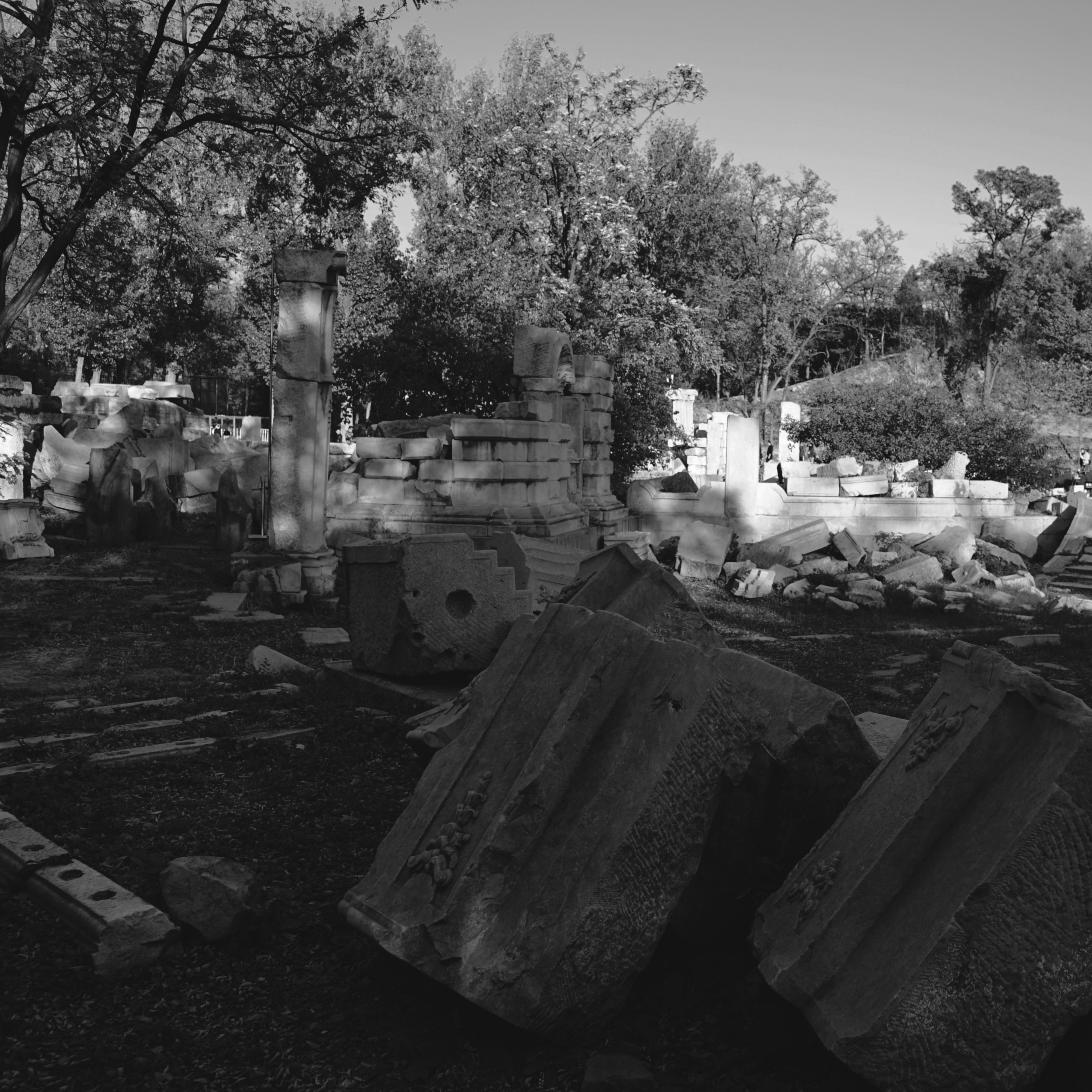
Compared to the vibrant life in the outer areas, the dilapidated state of the Western-style buildings in the Eternal Spring Garden’s European Palaces felt deeply regrettable. It’s a shame such fine architecture couldn’t be preserved. The exquisite craftsmanship of the time can still be glimpsed from the remaining walls and scattered stones.
Xieqi Qu (Harmonious Wonder) happens to be the area within the entire garden where the architectural stone carvings are most completely preserved. Here, one can see architectural components like colonnades and pedestals. Getting closer, you can observe the textures of the buildings in detail.


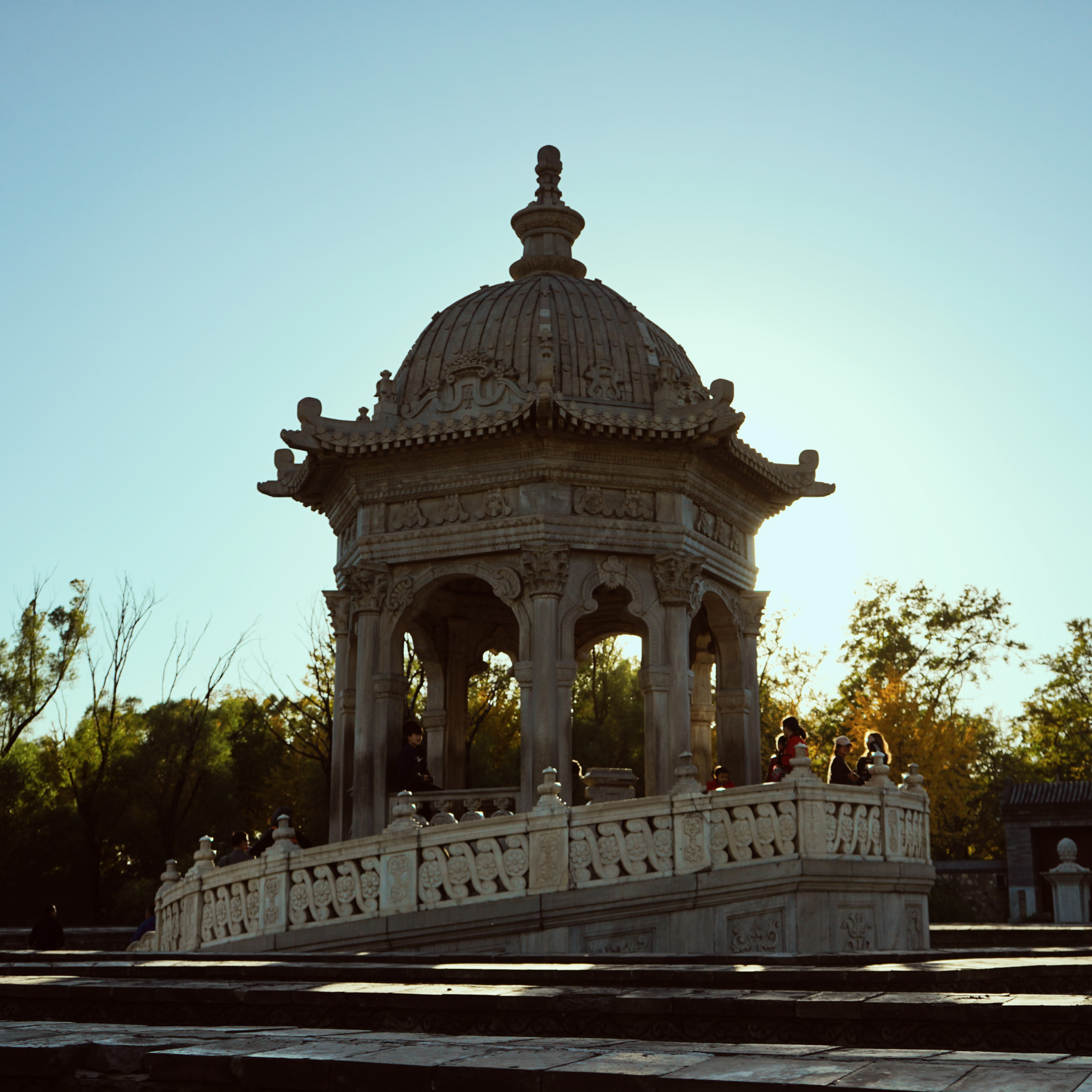
I walked a loop in the Maze (Wanhua Zhen) and got quite dizzy from the winding paths. Considering it was getting late, I took a photo of the round pavilion’s silhouette against the setting sun at dusk.
Haiyan Tang (Hall of National Peace) is the largest palace in the European Palaces. The main building faces west, with a large pool in front of the steps. On the left and right sides of the pool, arranged in a V-shape, were twelve bronze statues of animal-headed human figures (rat, ox, tiger, rabbit, dragon, snake, horse, sheep, monkey, rooster, dog, pig—the twelve zodiac animals). Each would spout water in sequence over a day and night, for one shichen (2 hours) each. At noon, all twelve zodiac animals would spout water together, commonly known as the “Water Clock.” Originally, they were European-style nude female statues, but Emperor Qianlong felt nude women were not in line with Chinese customs, so they were changed to the twelve zodiac animal heads, made of bronze.
Haiyan Tang is a famous scenic spot in the garden and also the placement point for the animal heads in Jackie Chan’s movie CZ12. The entire structure is very grand. Walking to the back of the area, you can still see the remains of the water reservoir from that time.
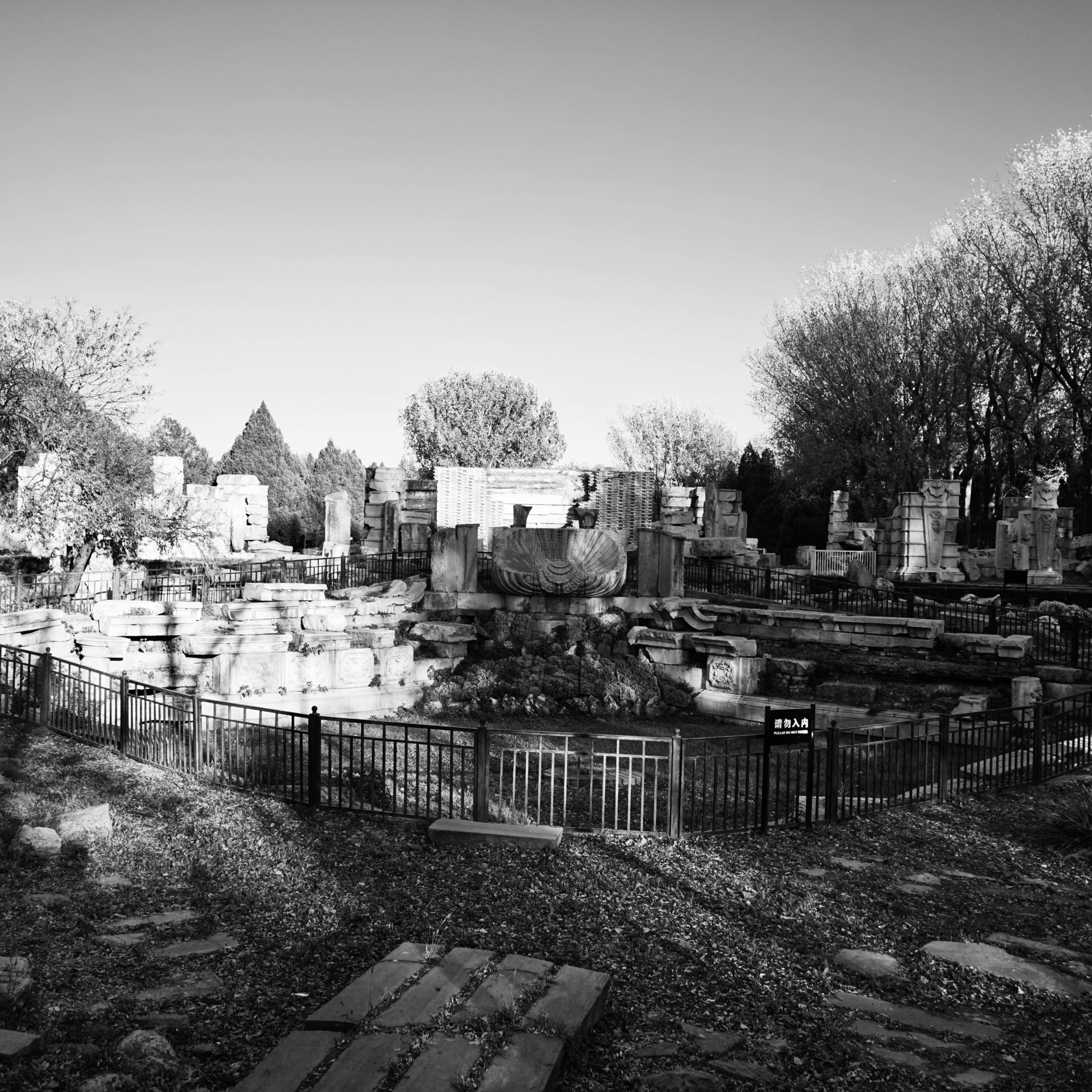

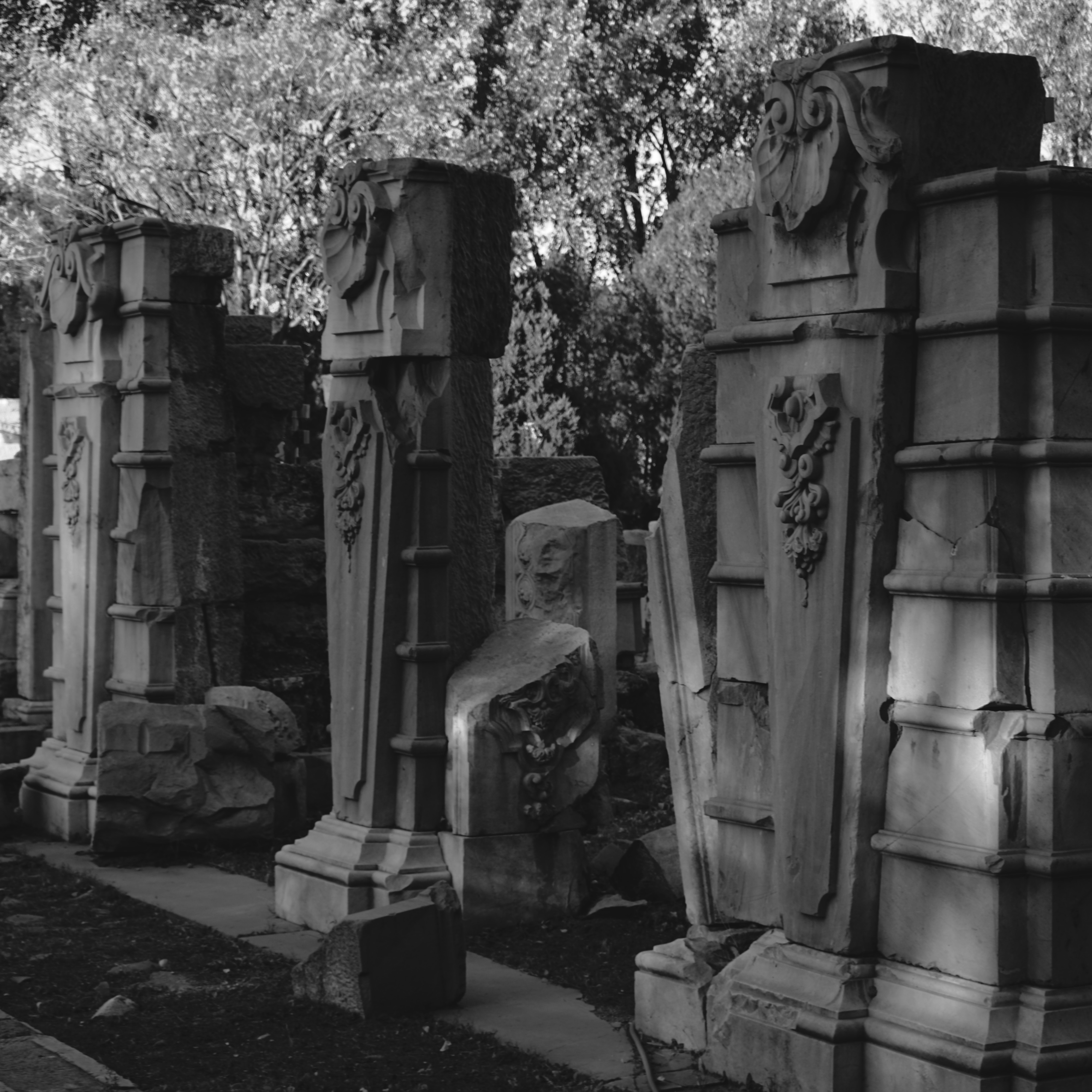
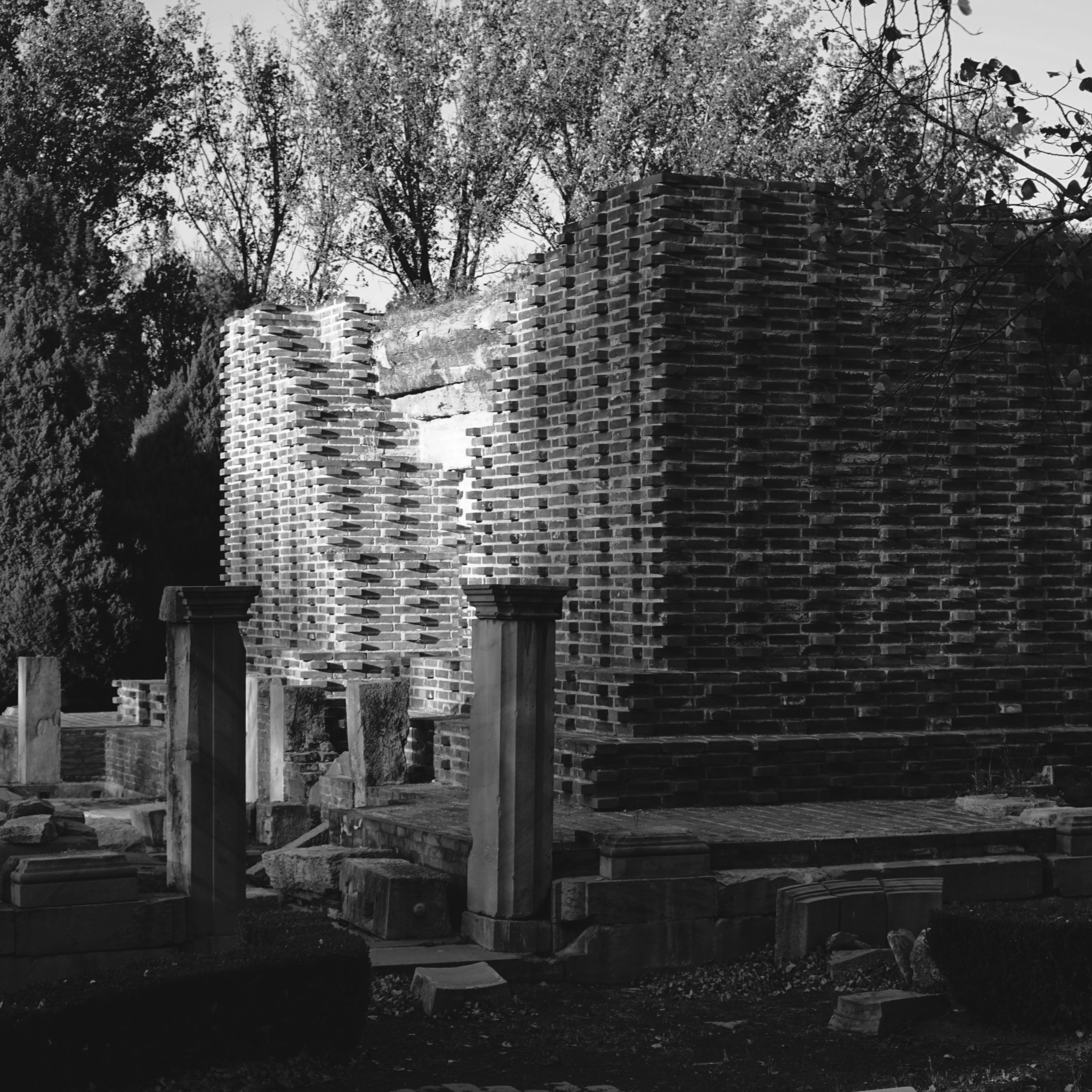

The Grand Waterworks (Dashuifa) was the most spectacular fountain in the European Palaces. The structure was designed in the style of a stone niche, resembling a gateway. Below, a large lion’s head spouted water, forming a seven-tiered water curtain. In front and below was an oval chrysanthemum-shaped fountain pool. At the center of the pool was a bronze plum blossom deer, with eight water jets from its antlers. On either side were ten bronze dogs, spouting water from their mouths directly at the deer’s body, creating layers of splashes. This was commonly called “Hunting Dogs Chasing the Deer.” To the left and right front of the Grand Waterworks stood two huge water-spouting pagodas. The pagodas were square, thirteen stories tall, with water jets from the top. Around the pagodas, eighty-eight copper pipes also spouted water together. In those days, the emperor would sit on the opposite Guanshuifa (Viewing the Waterworks) to admire this fountain group. British envoy Lord Macartney and Dutch envoy Isaac Titsingh, among others, once “gazed upon” the wonders of the waterworks here. It is said that if all these fountains were operating fully, it would be like a mountain torrent bursting forth, the sound audible for over a li (about 500 meters). Nearby, one would have to use hand gestures to converse. The grandeur can be imagined.
Only parts of the Grand Waterworks ruins’ architectural structure remain. With severe damage to the details, it’s very regrettable. Now, one can only glimpse its former glory through restoration drawings.

This Beijing trip comes to an end here. The entire journey was very pleasant. I saw the architectural landscapes I had long yearned to see and also met an important person. It is a very significant and happy travel memory in my life.
💡 Thank you for reading! Feel free to share the article or write to me to exchange thoughts.
The RSS address for this site has been updated. Please resubscribe, dear readers!